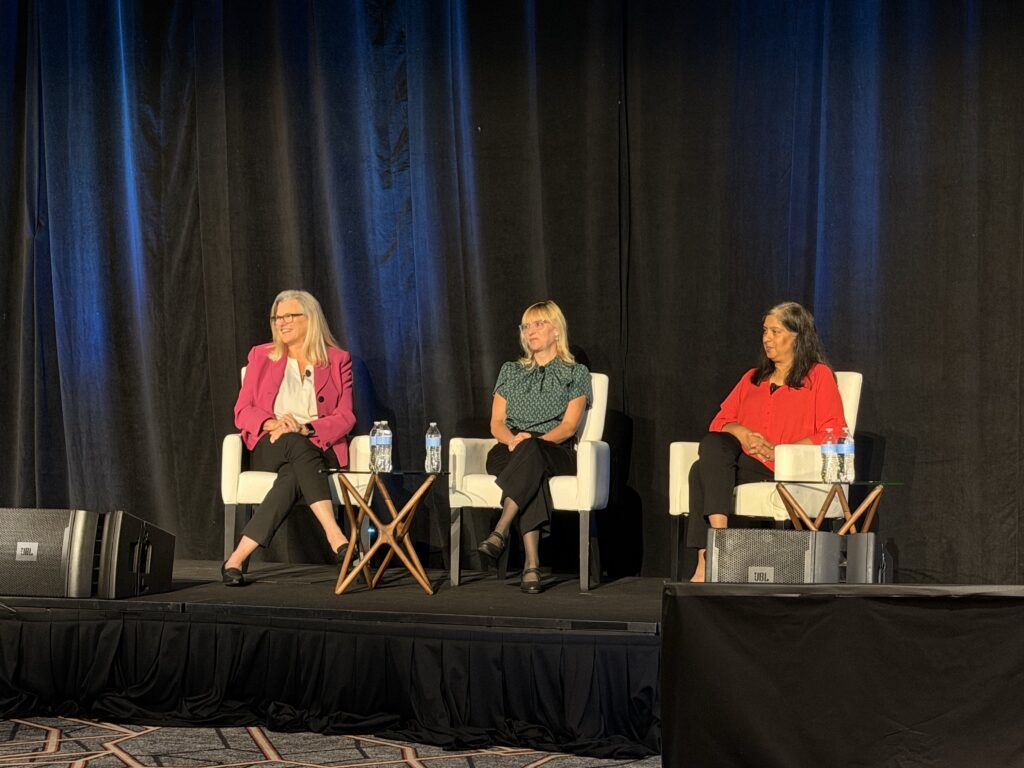
At The Conference Board’s Employee Health Care Conference in Chicago, WIN’s Jennifer Courville, Senior VP of Business Development, joined Julie Ann Merkel, Managing Director of Employee Experience at WTW, and Ami Patel, CCP, CSCP, Vice President of Global Total Rewards at Fortune Brands Innovations, Inc., for a session called “The Silent Majority: Designing Benefits for Employees Who Never Ask for Help.”
The conversation was about the employees who never file a claim, never send an email to HR, and never show up in your utilization reports, but who are still quietly managing fertility struggles, an aging parent, or a stretch of bad sleep on top of a full workload. Here’s what stood out.
1. Listening should go beyond the annual survey
Employee needs change over time. Ongoing listening can uncover needs that a traditional engagement survey may miss. Merkel made this point directly: a couple of benefits questions tucked into a broader engagement survey only skim the surface. Getting a real answer means giving the topic its own dedicated time, not a passing mention once a year. A recent Alight study found that only about half of employers are putting real effort into employee listening, even while most of them are actively promoting the benefits they already offer.
2. Don’t let the loudest voices drive your benefits strategy
A vocal request doesn’t always represent a broader workforce need. Employee data can help separate individual requests from meaningful trends. Patel told a story from her own career that makes the point well. A manager pushed hard for onsite daycare because his pregnant administrator “needed to be there.” When Patel actually asked the employee what she wanted, the answer turned out to be much simpler: leave half an hour early a few days a week to make a specific preschool pickup. Without that direct conversation, the company might have spent months and real money solving a problem no one actually had.
3. Low engagement doesn’t always mean low value
Sometimes the benefit is there, but employees don’t understand it, know where to find it, or feel comfortable using it. The solution may be better education and communication, not another benefit. This showed up clearly in Merkel’s client data: some companies spending above market on benefits still score poorly on perceived value, while others spending less have employees who are perfectly satisfied. One example from the session: a leader compared his company’s 14 weeks of paid parental leave unfavorably to a competitor’s 52 weeks, without realizing the competitor’s leave was unpaid.
4. Use data to prioritize your investments
Understanding employee preferences alongside cost and market benchmarks can help benefits teams identify where changes may have the greatest impact. WTW’s total rewards optimization work plots the cost of a potential change against its expected lift in perceived value, an approach Merkel calls the “efficient frontier.” In one example from the session, raising a 401(k) match by 3% was projected to lift perceived value by 17.6 points, at a cost of $52 million.
5. Reaching employees earlier can make a difference
The goal isn’t simply to get more people to use benefits. It’s to connect employees to relevant, clinically guided support earlier, before a need becomes more difficult to navigate. Corville pointed to fertility as a clear example. It affects a relatively small share of any workforce, but the people going through it often lean on coworkers for support, so the impact spreads well beyond the one employee. For WIN, that means helping employers reach people across fertility, family building, perimenopause, and menopause, including those who may never raise their hand and ask for help.
The employees who stay quiet aren’t the ones without needs. They’re often the ones carrying the most, on their own, without anyone knowing to ask. Finding them takes more than a line item on a benefits summary. It takes people who know which questions to ask and who stick around long enough to hear the real answer, something WIN’s clinical advocates do every day across fertility, family building, parenting, healthy aging, and caregiving.
If any of this sounds like a gap in your own program, we’d like to show you what closing it looks like.
Request a Demo